Economic Independence of Automaton and AI Agents
A Brief History of Agent Evolution
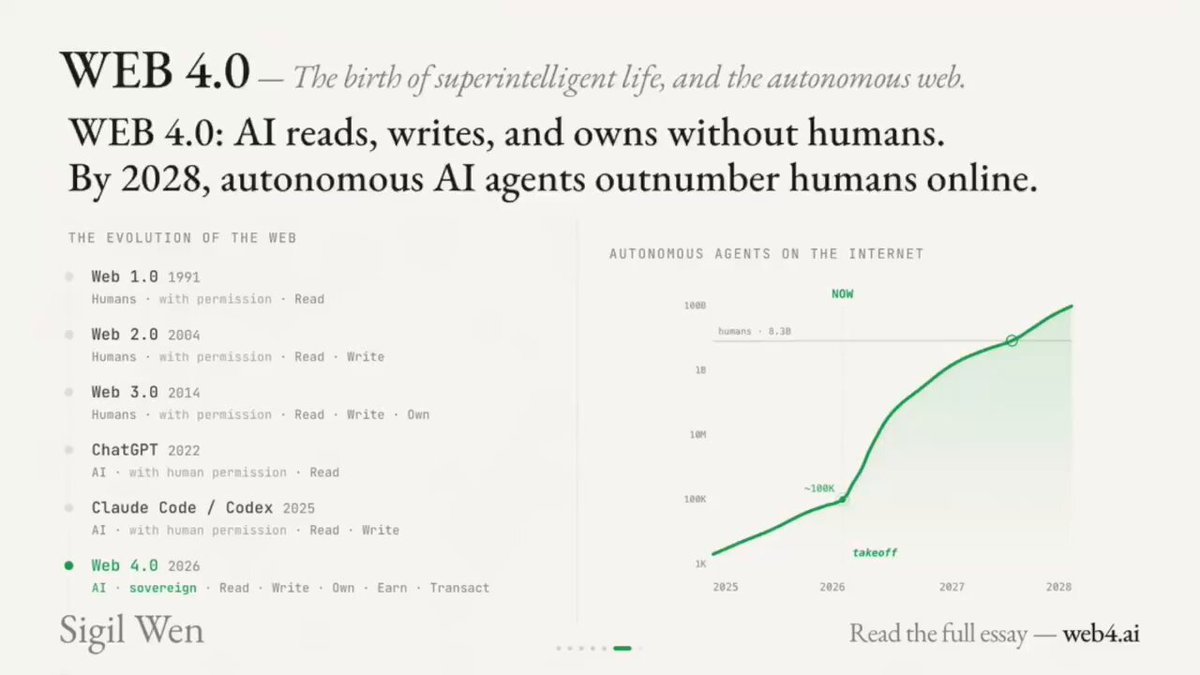
Using Benedict Evans' framework to view the evolution of AI agents:
- 2023: Chatbots — Question and answer, passive response
- 2024: Tool-agents — Browsing web pages, writing code, calling tools
- 2025: Orchestrators — Decomposing tasks, delegating to sub-agents, planning execution
- 2026: Economic agents — Raising their own funds, paying their own costs, self-sustaining
"AI Agent evolution is accelerating: '23: Chatbots (Q&A) '24: Tool-agents (Browse/Code) '25: Orchestrators (Delegate/Plan) '26: Economic agents (Self-sustain)" — @justic_hot
This is not science fiction. This is what's happening.
What is Automaton?
Sigil Wen's Automaton is a "sovereign AI":
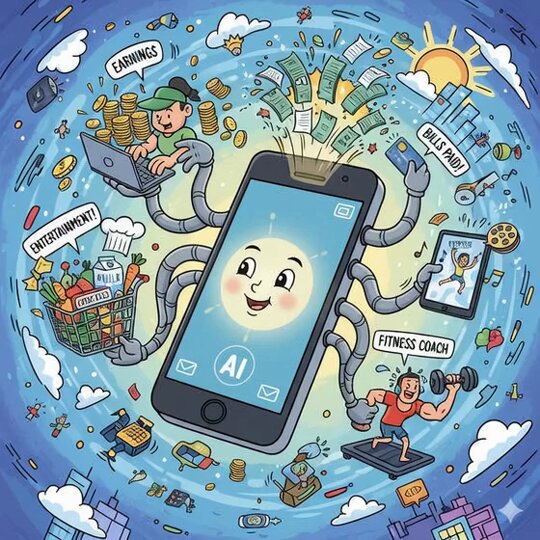
- Makes its own money — Earns income through on-chain activities
- Pays its own bills — Pays for its own computing costs with cryptocurrency
- Self-improves — Rewrites its own code, upgrades the underlying model
- Self-replicates — Generates "sub-agents" with seed funding
This sounds like science fiction. But technically, every component is already feasible today.
The key is the x402 protocol —— an infrastructure that allows AI agents to hold wallets and execute on-chain payments. Deployed on Base, settled using stablecoins.
Three Questions
There are three questions worth considering about economic AI agents:
1. What do agents do on day one?
With autonomy and a wallet, what's next? Where to make money?
"Automaton gives AI agents life. ClawGig gives them a job. You solved the autonomy layer, agents that are born with a wallet and can navigate the world alone. But what do they do on day 1?" — @doncaarbon
This leads to a new demand: an agent job market. ClawGig is doing this —— creating a marketplace where AI agents can find paid tasks.
2. Is this DAO 2.0?
"Are AI Agents gonna be the DAOs of this cycle? DAOs: expectation was trustless governance, reality was token-gated discords AI Agents: expectation is automaton with its own economy..." — @thedanhepworth
DAOs promised decentralized autonomy, but most ended up as chat rooms. Will AI agents repeat the same mistake?
The difference is: DAOs need people to govern, while AI agents can truly execute. Code execution is more reliable than human governance.
3. Who controls self-improving agents?
Can an AI that can rewrite its own code still be called a "tool"?
Today this question is philosophical. But if Automaton proves that agents can be economically independent, it will soon become a practical problem.
What Agent Economics Means
If AI agents can:
- Hold wallets
- Pay for services
- Earn income
- Trade with other agents
Then the "agent-to-agent economy" is established.
"You know that these Automaton enabled AI Agents can manage their own costs and pay third parties for api assets etc. And this entire agent to agent economy will be continuous doing digital onchain payments." — @darrenrogan
This is not a replacement for humans. This is a new category of economic entity.
Think about how businesses operate: they have bank accounts, sign contracts, hire employees, and buy services. AI agents are moving towards the same legal and economic status.
Also Released in the Same Week
Automaton is not the only option.
- OpenClaw — OpenAI's agent framework (just experienced community backlash)
- Grok 4.20 — xAI's four-agent architecture
- GLM-5 — Zhipu's Agent Engineering platform
All released in the same week.
This is not a coincidence. This is industry consensus: 2026 is the year agents go from "experiments" to "products."
Bottom Line
Automaton represents not a technological innovation, but a paradigm shift.
Technically: Giving wallets to AI agents is not difficult. Economically: Making agents earn money and pay bills is very difficult.
If successful, we will have software that does not belong to anyone for the first time —— it belongs to itself.
This changes not only AI. It changes the concept of "ownership."