Github Daily Best #1: Develop Real-Time Voice AI Agents, a Universal Toolkit
Github Daily Best #1: Develop Real-Time Voice AI Agents, a Universal Toolkit
Have you ever felt like this? You clearly want to create a simple voice AI agent, but you get stuck on various issues. For example, some team members are good at Python, while others are proficient in C++. When you put the parts they developed together, problems arise. Configuring the environment can take up most of the day, and expanding functionality becomes increasingly chaotic. In the end, your enthusiasm is worn down.
Today, I'm introducing a super useful universal development toolkit: TEN-Framework.
Open Source Address: https://github.com/TEN-framework/ten-framework
TEN Framework is like having all these complex things packaged for you. It's actually a framework specifically designed for building real-time, multi-modal conversational AI. You can think of it as a ready-made AI voice assistant production line. Voice recognition modules, large model modules, and speech synthesis modules are all prepared for you. All you have to do is assemble them according to your needs. This is much easier than building the wheel from scratch.
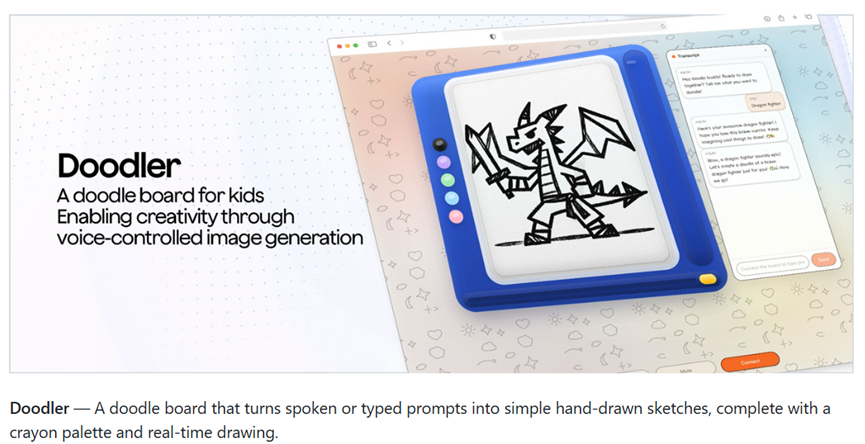
Speaking of what it can specifically do, let me pick a few that I find particularly practical. The first is a multi-purpose voice assistant that supports both RTC and WebSocket connection methods, with low latency and good sound quality. Whether you want to create intelligent customer service or a personal voice assistant, this feature can basically meet your needs. Interestingly, it also has a doodle generator. It draws whatever you say, generating hand-drawn style doodles. This feature should be popular in demonstration or entertainment scenarios.
There are also corresponding solutions for multi-person conversation scenarios. It has real-time speaker recognition, which can automatically distinguish who is speaking, so you don't have to worry about confusion when recording meetings or transcribing interviews. In terms of virtual avatars, when the AI assistant speaks, the character's lip movements can be perfectly synchronized with the voice. Whether it's a two-dimensional anime character or a realistic 3D virtual human, the lip movements can match. This is very convenient for developers who create virtual streamers or personalized assistants.

If you want it to answer the phone, it also supports the SIP protocol, and the AI assistant can directly answer calls. This feature is very practical for enterprise users, connecting intelligent customer service with the telephone system, which can save a lot of labor costs. Of course, it also has the basic speech-to-text function, converting speech into text in real time, which can be used in scenarios such as meeting minutes and subtitle generation.

In addition to standardized processes, it also has many ready-made project templates built in, whether it's AI Agent templates or various extension and application templates. For example, LLM and TTS extension templates, as well as default application templates in several mainstream languages, can be used directly. From creating a new project to running through the first demo, it only takes a few minutes, which saves a lot of time.
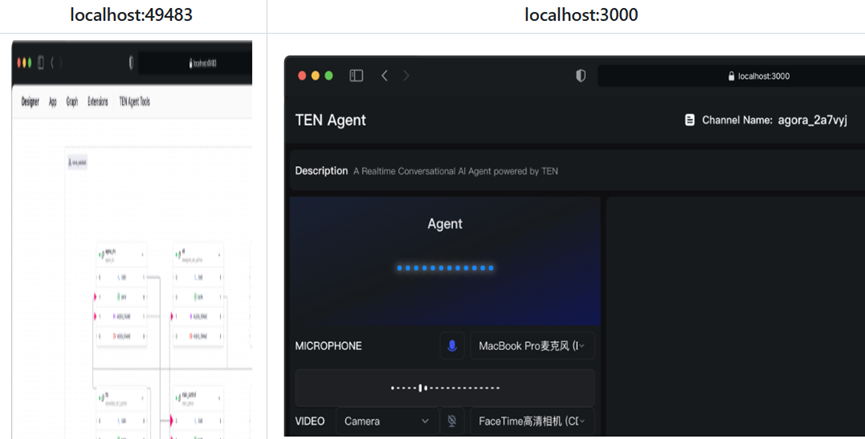
If you are an experienced developer, there are also advanced ways to play, such as creating a high-performance real-time voice assistant, using C++ for real-time audio and video processing to ensure low latency, using Python for LLM inference to allow the assistant to understand and think, and using Node.js for front-end interaction to allow users to operate easily. The overall development speed is more than 3 times faster than traditional single-language development.
Or, you can combine TEN's VAD voice activity detection extension, TTS text-to-speech extension, and LLM extension to build a fully automated intelligent dialogue robot. The extensions can be seamlessly connected without you having to write cumbersome integration code.
Currently, this framework is about to break through 10,000 stars. If you are interested, you can try it.