Open Source: 34.7K stars, Is Claude Code Outdated? This AI Programming Tool Dominates Claude Code
Open Source: 34.7K stars, Is Claude Code Outdated? This AI Programming Tool Dominates Claude Code
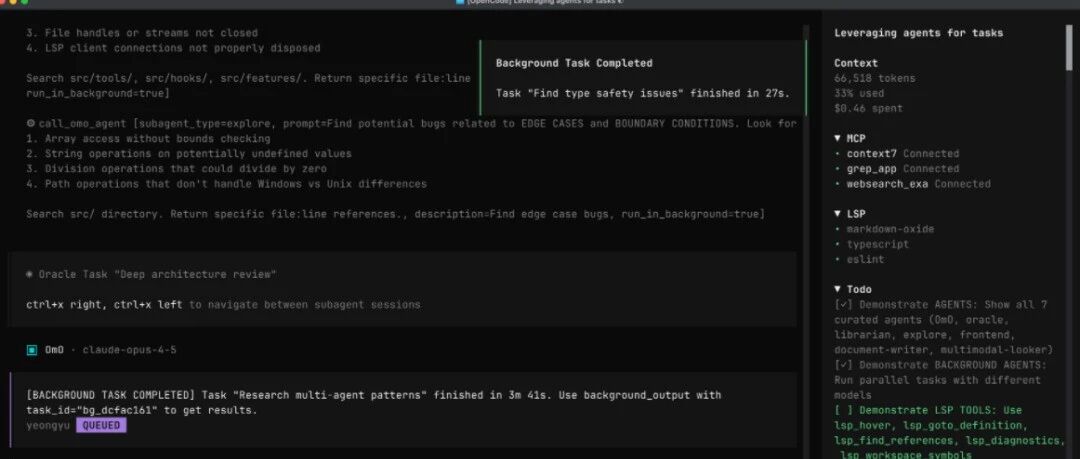
Recently, a name has been trending in the community: oh-my-opencode.
Many people say it is the "best proxy framework," allowing AI to write code and manage projects like a real development team. The most impressive part is that it is completely open source and free, with almost no barriers to use for individuals and startups.
What exactly is this amazing project? Why has it suddenly become so popular? Let's discuss it in plain language today.
🤔 First, let's clarify: What exactly is it?
Strictly speaking, oh-my-opencode is not an independent AI but a "orchestration layer/plugin" running on OpenCode.
You can think of it as:
- OpenCode: An open-source AI programming assistant that can write code, read code, and run commands, supporting dozens of models.
- oh-my-opencode: It equips OpenCode with a "multi-agent collaboration system + best practice configuration," upgrading it from "solo operation" to "team operation."
In summary:
OpenCode is the engine, and oh-my-opencode provides a full AI development team and a set of automated processes.
📜 How did it come about?
The story starts with Claude Code. For the past year or two, Claude Code has been synonymous with AI programming, but it has several pain points:
- Closed source and expensive: Monthly subscription with a hefty price.
- High usage threshold: Unfriendly network for domestic users and restrictions on enterprise use.
- Black box: Core logic is opaque and cannot be customized.
After OpenCode gained popularity, people realized that relying on a single model to write code still led to "context explosion" and tasks stopping halfway when handling complex projects. Thus, the community began to think:
"Can we let multiple AIs collaborate, like a real team, with some designing, some coding, and some testing?"
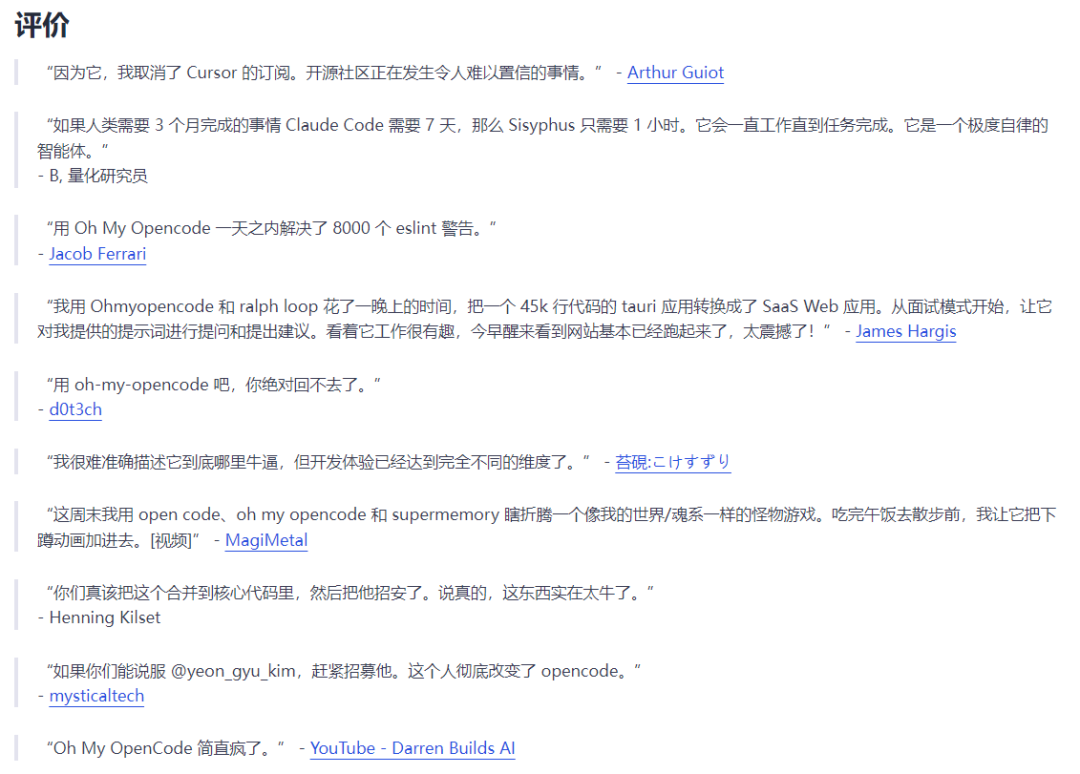
oh-my-opencode is the product of this idea. It started as a community plugin and gradually developed into a complete multi-agent orchestration solution, with 34.7K stars on GitHub, praised by many developers as the "best open-source alternative to Claude Code."
⚙️ How does it work "like a team"?
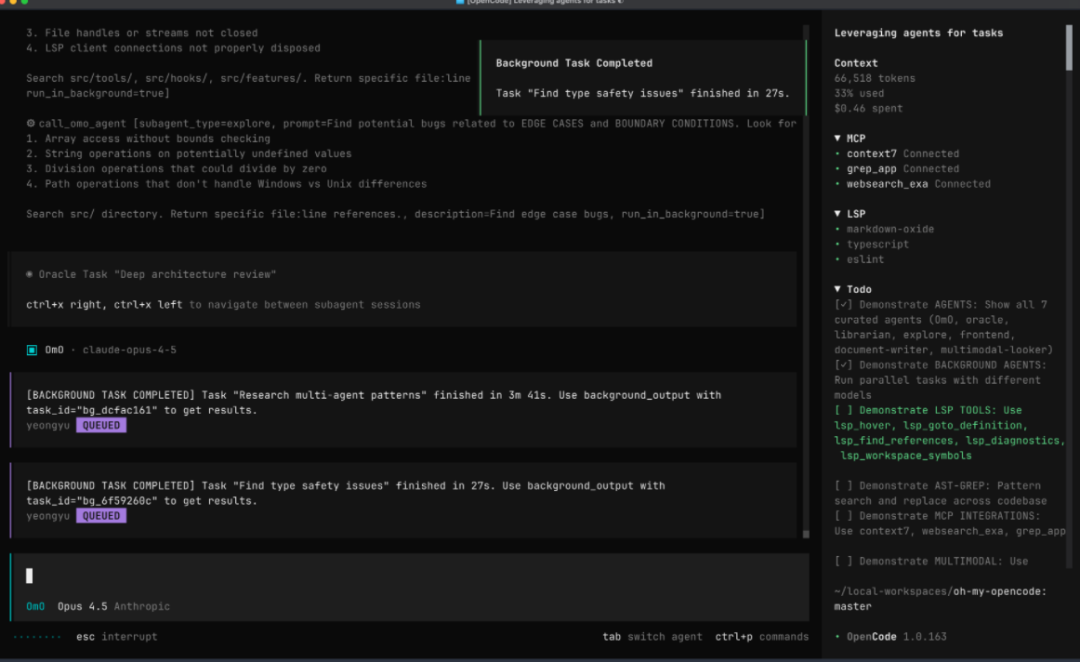
In simple terms, its core is a main orchestration agent + a group of specialized sub-agents + a set of automated task processes.
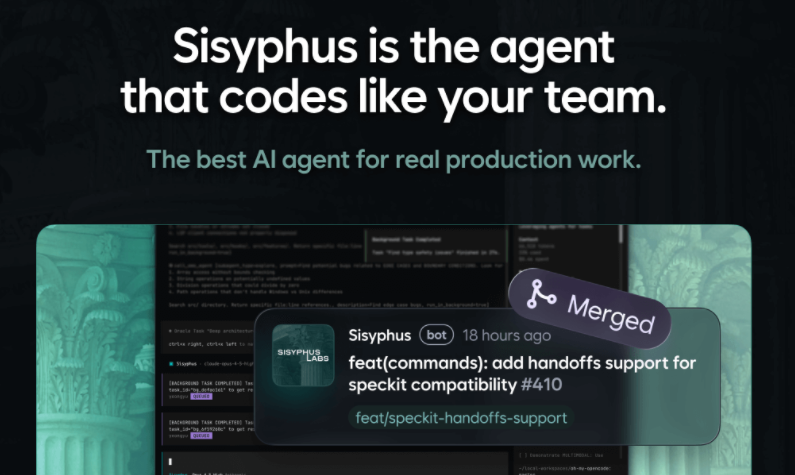
1. Main Orchestrator: Sisyphus
Sisyphus is the default main agent, acting as technical supervisor + project manager. Its tasks include:
- Understanding your requirements and breaking them down into specific tasks.
- Assigning tasks to suitable sub-agents (such as front-end, back-end, architects, etc.).
- Supervising task execution to ensure it stays on track until all TODOs are completed.
2. Specialized Sub-Agents: Each with Their Role
In addition to Sisyphus, there are a series of clearly defined sub-agents:
- Prometheus / Metis / Momus: Responsible for planning, risk analysis, and plan review, ensuring the feasibility of the solution.- Oracle: Architect + Senior Debugging Expert, responsible for solution review and complex problem diagnosis.
- Librarian: Document and code repository researcher, responsible for consulting official documentation and project code.
- Explore: Code repository exploration expert, quickly locating relevant files and code patterns.
- Frontend UI/UX Engineer: Frontend engineer, specifically responsible for UI and interaction implementation.
- Hephaestus: Deep craftsman, responsible for complex refactoring and deep development across files and modules.
- Multimodal Looker: Multimodal analyst, capable of understanding content from PDFs, images, charts, and more.
3. Automation Process: From "Saying" to "Doing"
When you submit a complex task, the process generally goes as follows:
- Sisyphus receives the task and calls planning agents like Prometheus to create a detailed plan.
- Sisyphus breaks the plan down into subtasks and assigns them to Oracle, Librarian, Frontend, etc. for execution.
- Each agent works in parallel, using technologies like LSP and AST to deeply understand the code, ensuring the accuracy of modifications.
- Sisyphus monitors all tasks, automatically handling dependencies and conflicts, ensuring the tasks are ultimately completed.
4. Key "Magic": Ultrawork Mode
To make AI "go all out," simply add ultrawork or ulw to your instructions. This will trigger the "fully automated development mode":
- Automatically schedules multiple agents in parallel.
- Background tasks continue running, even if you close the terminal.
- Agents automatically hand off tasks until all TODOs are completed.
👍 What is its strength?
1. Completely open-source and free, controllable costs
- Free tools: oh-my-opencode itself is an open-source project under the MIT license, with no subscription fees.
- Transparent costs: You only need to pay for the underlying large model APIs you use (such as OpenAI, Gemini, etc.), and you can freely choose free or low-cost models.
2. More like a "real team" rather than "advanced copy-paste"
Traditional AI assistants operate on a "question and answer" basis, while oh-my-opencode can achieve a complete process from requirement analysis to code implementation, even automatically handling testing and fixes.
3. Deep integration with development tools, reducing "guesswork"
By integrating LSP and AST, AI can truly "understand" your code, knowing variable definitions and function call relationships, making refactoring safer and more accurate.
4. User-friendly for domestic users, with network and cost advantages
- Network friendly: Can be paired with domestic models like Zhipu GLM, MiniMax, ensuring stable access.
- Lower costs: A large number of free models are available, making costs far lower than subscription-based tools for individuals and small teams.
5. Active community and rich ecosystem
As an open-source project, it has an active community contributing, with new features, new agents, and new MCP plugins constantly being added, offering high playability and extensibility.
⚔️ How does it compare to Claude Code and others?
Features oh-my-opencode + OpenCode Claude Code Other AI programming assistants (like Cursor)
Cost Structure Free tools, only pay for model API fees, controllable costs. Mandatory subscription, monthly payments, high long-term costs. Subscription + points or pay-as-you-go, costs are not transparent.
Model Selection Over 75 types, open-source, local, and domestic models available. Limited to Claude series, vendor lock-in. Dependent on partners, relatively limited choices.
Transparency Completely open-source, auditable, customizable, and forkable. Completely closed-source, black box model, cannot be customized. Partially open-source or completely closed-source.
Privacy Compliance Data does not leave the domain, suitable for high-demand industries like finance and healthcare. Data needs to be uploaded, with compliance risks. Dependent on third parties, weak data control.Automation Level High, supports multi-agent collaboration and fully automated mode. Medium, relies on the model's own capabilities, the process is relatively fixed. Medium, primarily single-agent, complex tasks require human intervention. Ease of Use Medium, requires understanding of multi-agent concepts, but configurations can be reused. Low, ready to use out of the box, smooth experience. Low, user-friendly interaction, low learning cost. ## 🚀 Summary: How Should I Choose? If you are a personal developer, student, or startup, with a limited budget and want to experience cutting-edge AI programming capabilities, then oh-my-opencode + OpenCode is definitely worth a try. If you pursue extreme stability and enterprise-level support, and have a sufficient budget, then commercial tools like Claude Code may be more suitable for you. But in any case, the emergence of oh-my-opencode has completely changed the landscape of AI programming tools. It shows us that: the future of AI programming must be open-source, multi-agent, and customizable. If you also want to experience the feeling of "one person is a development team," you might as well start by installing OpenCode and oh-my-opencode.