OpenClaw Embraces ACP: The 'USB-C Moment' of AI Programming Has Arrived
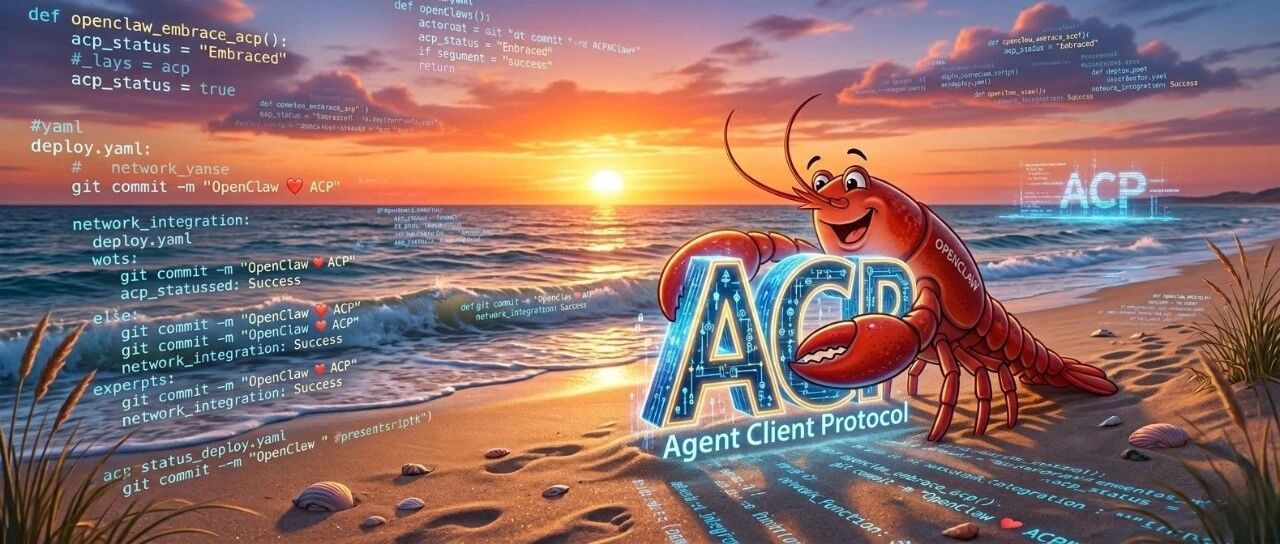
OpenClaw Embraces ACP: The 'USB-C Moment' of AI Programming Has Arrived
TL; DR OpenClaw transforms the "AI Programming Assistant" from isolated apps into a freely combinable "plugin ecosystem" through acpx + ACP - just like how VS Code + LSP liberated language support back in the day.
1. What is ACP? Explained in One Sentence
ACP (Agent Client Protocol) is the "universal interface" connecting code editors with AI programming assistants.
Imagine that USB-C port on your desk - whether it's a phone, tablet, or laptop, one cable can charge and transfer data. ACP is the USB-C of the AI programming world: it allows any compatible AI programming assistant (agent) to connect to any editor that supports the protocol.
This protocol was born out of the practical needs of the Zed editor team. When they wanted to integrate Google's Gemini CLI, they found there was no standard way to achieve it. So they built ACP themselves, and unexpectedly, this solution quickly evolved into a community standard, with mainstream editors like JetBrains and Neovim joining in support.
Technical Architecture Overview
ACP uses JSON-RPC 2.0 as its communication protocol: local agents communicate with the editor through stdio pipes, while remote agents use HTTP/WebSocket. It reuses the JSON representation of MCP (Model Context Protocol) but adds specific type definitions for programming scenarios - such as diff (code differences), which is a core element of agentic coding.
2. What Pain Points Does ACP Address?
Before ACP, the AI programming ecosystem faced three major headaches:
1. High Integration Costs
Each new agent-editor combination requires significant custom development from both sides. Agents must learn the editor's private API, and editors need to write adaptation layers for each agent.
2. Limited Compatibility
Developers are often forced to choose one: either use their preferred agent with limited editor support or stick with a familiar editor and miss out on powerful agents. There is no middle ground.
3. Vendor Lock-In Risks
Once a specific agent is chosen, it means accepting its entire ecosystem - the cost of switching tools can be daunting.
The solution approach of ACP is reminiscent of the LSP (Language Server Protocol) from back in the day: establish a unified protocol that allows agents implementing ACP to run in any compatible editor.
3. What is the Relationship Between ACP, MCP, A2A, and Other Protocols?
- ACP - Agent Client Protocol (initiated by Zed), scope: Editor ↔ Agent - MCP - Model Context Protocol (initiated by Anthropic), scope: Agent ↔ Tool - IBM ACP - Agent Communication Protocol, scope: Agent ↔ Agent - A2A - Agent-to-Agent Protocol (initiated by Google), scope: Agent ↔ Agent
MCP is responsible for "vertical connections" (Agent to Tool), while ACP/A2A handles "horizontal connections" (Agent to Editor or between Agents). They are not competitors but complementary.
4. OpenClaw's ACP Integration: What is acpx?
OpenClaw introduced ACP support in version 2026.2.26. The core component acpx is a headless CLI client specifically designed to manage stateful ACP sessions.
What Can acpx Do?
Full Lifecycle Management of Sessions - /acp spawn —— Create a new ACP session - /acp steer —— Send commands to a running session - /acp cancel —— Cancel the current task - /acp close —— End the session - /acp status —— Check the session status - /acp doctor —— Diagnose connection issues
Out-of-the-Box Multi-Agent Support - pi —— Lightweight agent - claude —— Claude Code - codex —— GitHub Copilot Codex - opencode —— Open-source agent solution - gemini —— Google Gemini CLI
How to Enable?
{ "acp":{ "enabled":true, "dispatch":{"enabled":true}, "backend":"acpx", "defaultAgent":"codex", "allowedAgents":["pi","claude","codex","opencode","gemini"], "maxConcurrentSessions":8 } }
5. Enhanced Capabilities with ACP + OpenClaw
- Editor-Independent Freedom: Call any supported agent in your preferred editor - Escape Vendor Lock-In: Switching agents requires only changing one line of configuration - Composable Full-Stack AI Workflows: Combine MCP + ACP to build powerful pipelines - Access to a Thriving Ecosystem: 20+ agents and 10+ editors support ACP - Multi-Agent Collaboration Becomes Possible: Codex writes code → Claude reviews → Gemini generates tests
6. Real-World Scenario: Feishu + OpenClaw + ACP Trio
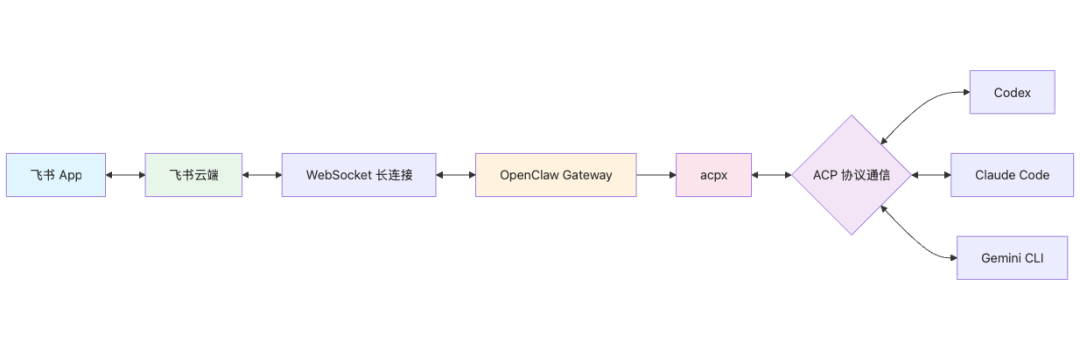 Key Advantage: When using WebSocket mode, no public IP, no domain name, and no internal network penetration are needed; your computer connects directly to the Feishu cloud.
Changes Brought to the Team
- Technical Lead: Uses Feishu to schedule Codex for code reviews, allowing agents with different expertise to perform their roles - Team Members: No need to understand ACP/acpx, no need to install CLI tools; the Feishu interface uses natural language to invoke AI - The Entire Organization: AI programming capabilities transition from personal tools to shared resources within the team
7. Final Thoughts
The emergence of ACP marks the transition of AI programming tools from the "island era" to the "connected era". OpenClaw's support for ACP - especially the launch of acpx - transforms it from merely a conversational AI assistant into a multi-agent orchestration hub.
Next Steps to Explore: - Configure OpenClaw + acpx to experience collaboration with different agents - Focus on scenarios where MCP and ACP are used together - Keep an eye on new agents joining the ACP ecosystem
Reference Links
- https://agentclientprotocol.com - https://zed.dev/acp - https://www.contextstudios.ai/blog/acp-vs-mcp-the-protocol-war-that-will-define-ai-coding-in-2026 - https://github.com/openclaw/acpx - https://docs.openclaw.ai/tools/acp-agents - https://github.com/AlexAnys/feishu-openclaw