Robot Fighting League and Market Share: Chinese Humanoid Robots Are Defining New Rules
In 2026, humanoid robots are no longer just conceptual products at tech exhibitions. They dance Kung Fu on the Spring Festival Gala, train at the Shaolin Temple, and compete for gold belts in the fighting arenas of Shenzhen.
Market Landscape is Set
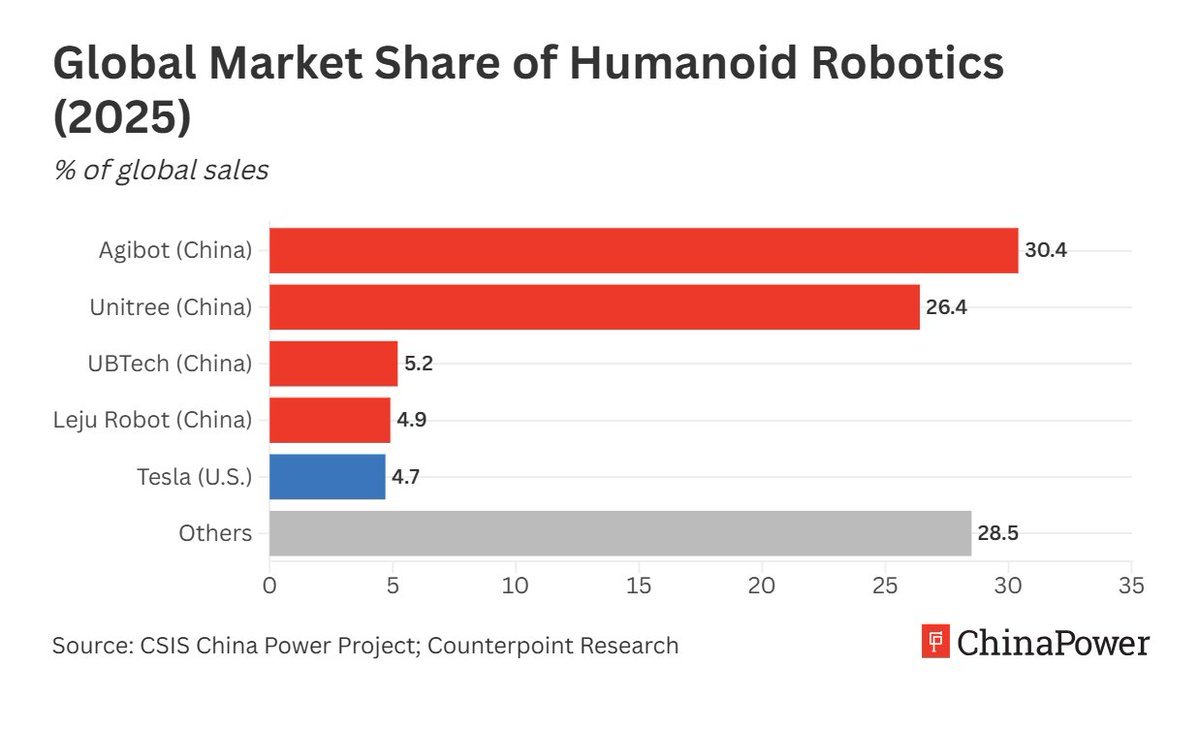
According to the latest market share data:
- Agibot (China): 30.4%
- Unitree (China): 26.4%
- UBTech (China): 5.2%
- Leju Robot (China): 4.9%
- Tesla (USA): 4.7%
Chinese companies occupy 67% of the global humanoid robot market. This is not accidental.
From Spring Festival Gala to Fighting Arena
Discussions on X reveal two key events:
Spring Festival Gala Performance: Unitree robots performed Kung Fu and breakdancing on the 2026 Spring Festival Gala, letting 1.4 billion Chinese people "know where the future lies."
"The significance of the humanoid robot's performance lies in letting 1.4 billion Chinese people know where the future lies." — @CyberRobooo
Fighting League: Shenzhen launched the 2026 season of the "Ultimate Robot Knockout Legend" league, where humanoid robots compete for gold belts in the ring.
This is not entertainment. This is stress testing—the reaction speed, balance ability, and impact resistance in fighting scenarios are all preliminary verifications for industrial scenarios.
Agibot A3: Training at Shaolin Temple
The most disturbing video comes from Agibot A3:
- Backflip
- Flying kick shattering glass
- Drunken fist movements
"A robot just did a backflip, shattered glass with a flying kick, and pulled off drunken master moves. All in one take. AGIBOT A3 finished its training at the Shaolin Temple." — @heyshrutimishra
When robots start training at the Shaolin Temple, it's hard to say this is just a "laboratory product."
America's Dilemma
Tesla's Optimus only accounts for 4.7% of the market share. The reason is simple:
| Dimension | China | USA |
|---|---|---|
| Policy | National strategic support | Market-driven |
| Production Capacity | Mass production | Proof of concept stage |
| Price | $13,600 (Unitree G1) | $20,000 (Expected) |
| Application Scenarios | Spring Festival Gala, fighting, factories | Factories (Planned) |
Elon Musk's judgment is correct:
"Once the solar energy generation to robot manufacturing to chip fabrication to AI loop is closed, conventional currency will just get in the way. Just wattage and tonnage will matter, not dollars." — @elonmusk
But the problem is: China is completing this closed loop faster.
Security Risks
There is a noteworthy security warning on X:
"Una aspiradora robot tenía tan mala ciber seguridad que un programador jugando a manejarla con un joystick descubrió que no soló manejaba la suya sino otras 7000 alrededor del mundo." — @maxifirtman
A security vulnerability in a robot vacuum cleaner allowed a hacker to control 7,000 devices worldwide, view cameras, and map houses.
When robots enter homes and factories, cybersecurity is physical security.
Israel's "Mechanical Octopus"
It's not just China making robots. Israel showcased the "Mechanical Octopus" robot:
- Reduces tank cleaning time from 48 hours to 2 hours
- Multi-arm design, can penetrate engines, clean equipment, and locate faults
This is a typical example of vertical application—not making general-purpose robots, but only improving efficiency in specific scenarios.
Bottom Line
2026 may really be the "Year Zero of Robots." But this Year Zero is not defined by Silicon Valley, but by Shenzhen.
China's robot strategy is clear:
- Use national-level exposure (Spring Festival Gala) to build awareness
- Use extreme scenarios (fighting, Shaolin Temple) to verify capabilities
- Use price advantages ($13,600) to capture the market
- Use economies of scale to lower costs
Can the United States catch up? Maybe. But the prerequisite is to admit: This is not a fair competition, but an industrial reshaping driven by national will.