The Economics of Vibe Coding
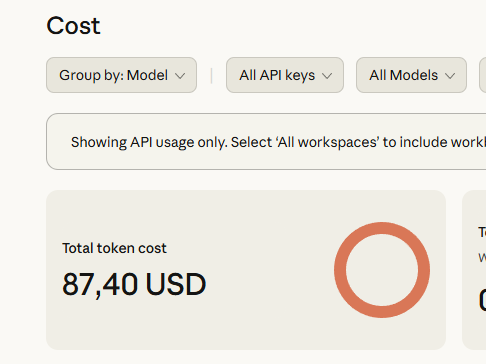
€74.
That's how much it cost a French developer to do "vibe coding" for a day using Claude Code. He made the craziest website he's made in over ten years.
Expensive? Or cheap?
It depends on how you calculate it.
What is Vibe Coding?
Vibe coding isn't a formal term, but you'll understand it as soon as you see it.
You have an idea. You open Claude Code. You start describing what you want. Claude asks a few questions. You answer. Code starts appearing.
You're not writing code. You're talking to an AI, and the code is a byproduct.
"It cost me €74 to make the craziest website I've ever made in over ten years of site building. And that's my first attempt—lots of mistakes, little optimization." — @jeremyrglt
Changing Cost Structures
Traditional software development: Time × Hourly Rate = Cost
Vibe coding: Token Usage × Token Price = Cost
These are completely different.
In the traditional model, complexity increases costs linearly. Complex projects require more time and more engineers.
In vibe coding, the impact of complexity is non-linear. Sometimes a complex feature only requires a single description. Sometimes a simple feature requires repeated debugging.
The Luxury of Opus 4.6
A Japanese developer wrote:
"At work, I have unlimited Opus 4.6 via Claude Code. When I use Sonnet privately, I can't help feeling it's not enough." — @akirugaishi
This is a real difference in experience. The difference between Opus 4.6 and Sonnet isn't 10% or 20%, but a qualitative change that can be felt.
When tools become infrastructure, this gap widens. It's like getting used to a 4K monitor and then going back to 1080p.
The Discoverability Problem of Plugins
"Marketplace for Claude Code plugins is exactly what's needed. Discoverability is hard—I've probably missed dozens of useful plugins just because I don't know they exist." — @saen_dev
This is an inevitable stage in platform evolution.
First comes the core product. Then come the plugins. Then comes the discovery mechanism.
Claude Code is evolving from a tool into a platform. But platforms need ecosystems, and ecosystems need discoverability.
Conclusion
Vibe coding is changing the economics of software development.
Cost is no longer time, but tokens. The bottleneck is no longer coding speed, but the ability to express oneself.
€74 to make ten websites? Maybe.
But more likely: you no longer want to "make ten websites." You only want to make one that you really want to make.