Token Consumption Plummets by 80%, Cloudflare Enables Native Markdown Support for Servers: OpenClaw Must Be Laughing
Token Consumption Plummets by 80%, Cloudflare Enables Native Markdown Support for Servers: OpenClaw Must Be Laughing
Cloudflare has just released a new feature called Markdown for Agents. This new feature allows web servers to directly feed Markdown-formatted data to AI Agents, completely abandoning bloated HTML.
Real-world test data shows that Token consumption has plummeted by 80%. This means lower inference costs and faster response times.
Why is this important?
The current internet is designed for human eyes, not for large models.
Feeding raw HTML to AI is like paying per word to read the packaging of a parcel instead of reading the letter inside.
A simple web page title, written in HTML as <h2 class...>, contains various irrelevant Class, ID, and Div wrappers, which not only consume 12-15 Tokens but are also full of noise with no semantic value. But if converted to Markdown's ##, it only requires 3 Tokens.
Cloudflare tested a blog post:
- The HTML version weighed 16180 Tokens
- After conversion, only 3150 Tokens remained
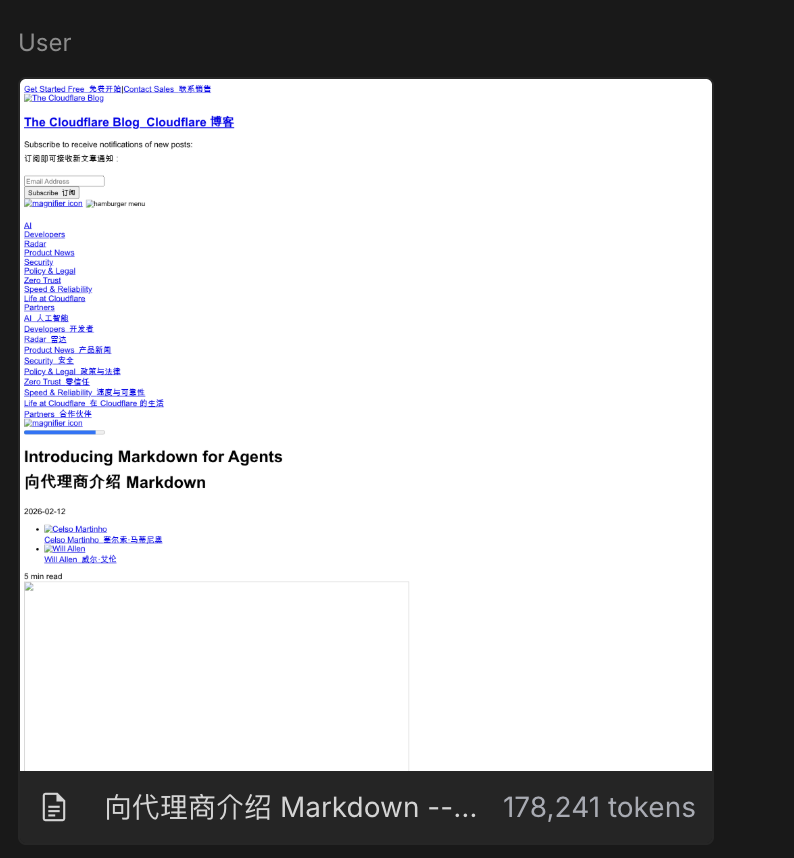
I also tried it, throwing the HTML of Cloudflare's Markdown for Agents blog post directly into Google AI Studio, which directly parsed out 178,241 tokens. This is simply too anti-AI.
This is why Markdown is becoming the lingua franca of the AI era.
How does it work?
Cloudflare's solution is very clever. It doesn't require you to modify the origin code, but instead utilizes the standard Content Negotiation mechanism.
When AI Agents like Claude Code or OpenClaw make a request, they include Accept: text/markdown in the Header.
When Cloudflare's network edge node detects this request, it fetches the HTML from the origin and converts it to Markdown in real-time before returning it to the Client.
This is like hanging an automatic translator on your website: humans see HTML, machines see Markdown.
The response header also includes x-markdown-tokens. This allows the AI Agent to know the estimated number of Tokens in the document before processing the content, making it easier to calculate context window strategies.
Not just saving bandwidth, but also control
In addition to format conversion, Cloudflare also introduces a Content-Signal mechanism.
The response header will contain tags like ai-train=yes or search=yes. This means that content creators can explicitly declare whether their data is allowed to be used for AI model training or whether it is allowed to enter the search index.
This establishes a set of traffic rules for the chaotic AI crawler world.
More hardcore details
For scenarios that cannot be automatically converted, Cloudflare also provides manual tools:
- Workers AI: Supports the
AI.toMarkdown()method, which can not only convert HTML but also handle various documents such as PDFs, and even supports automatic summarization. - Browser Rendering API: For dynamic pages with heavy JS, you can first render them in the cloud browser and then output plain text through the
/markdownendpoint.
At the same time, Cloudflare Radar has also updated its data dimensions. Now you can specifically track the MIME type distribution of AI crawler requests. Data shows that OpenAI's OAI-Searchbot has already started to obtain Markdown data in large quantities through this method.
Available immediately
This feature is currently in Beta.
All Pro, Business, Enterprise plans, and SSL for SaaS users can enable it for free.
Just turn on the Markdown for Agents switch in the quick actions of the console, and your website will instantly become AI-friendly.
The internet infrastructure is evolving from Human-First to Agent-First.
Detailed information: https://blog.cloudflare.com/markdown-for-agents/