After Testing MiniMax M2.5, I Started to Doubt Whether I Should Renew Claude...
MiniMax M2.5 is out! I immediately connected to Claude Code for testing.
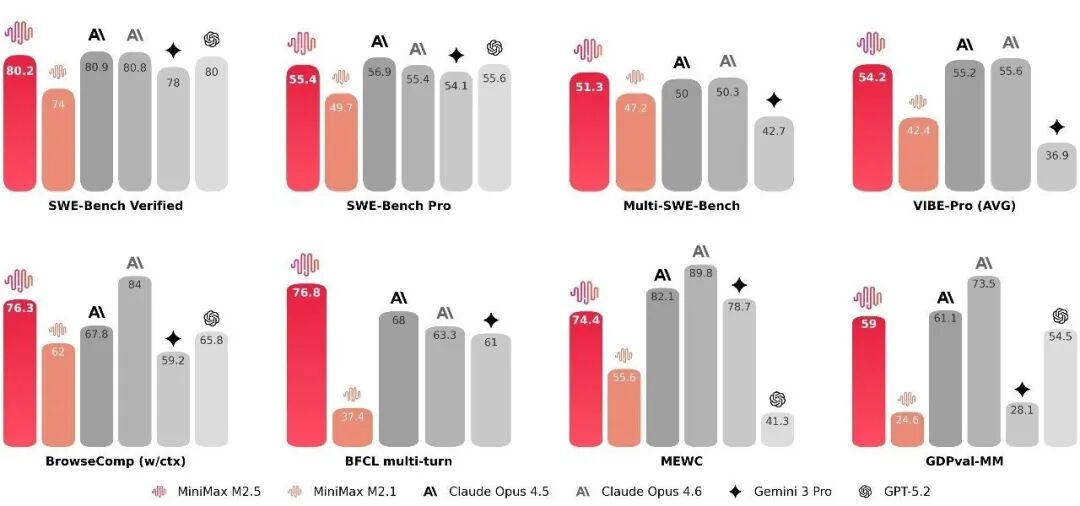
This time it's really different. The scorecard officially released by MiniMax is quite explosive.
SWE-Bench Verified scored 80.2%, Multi-SWE-Bench multi-language programming directly took first place, and BrowseComp's search capability also reached a SOTA level of 76.3%.
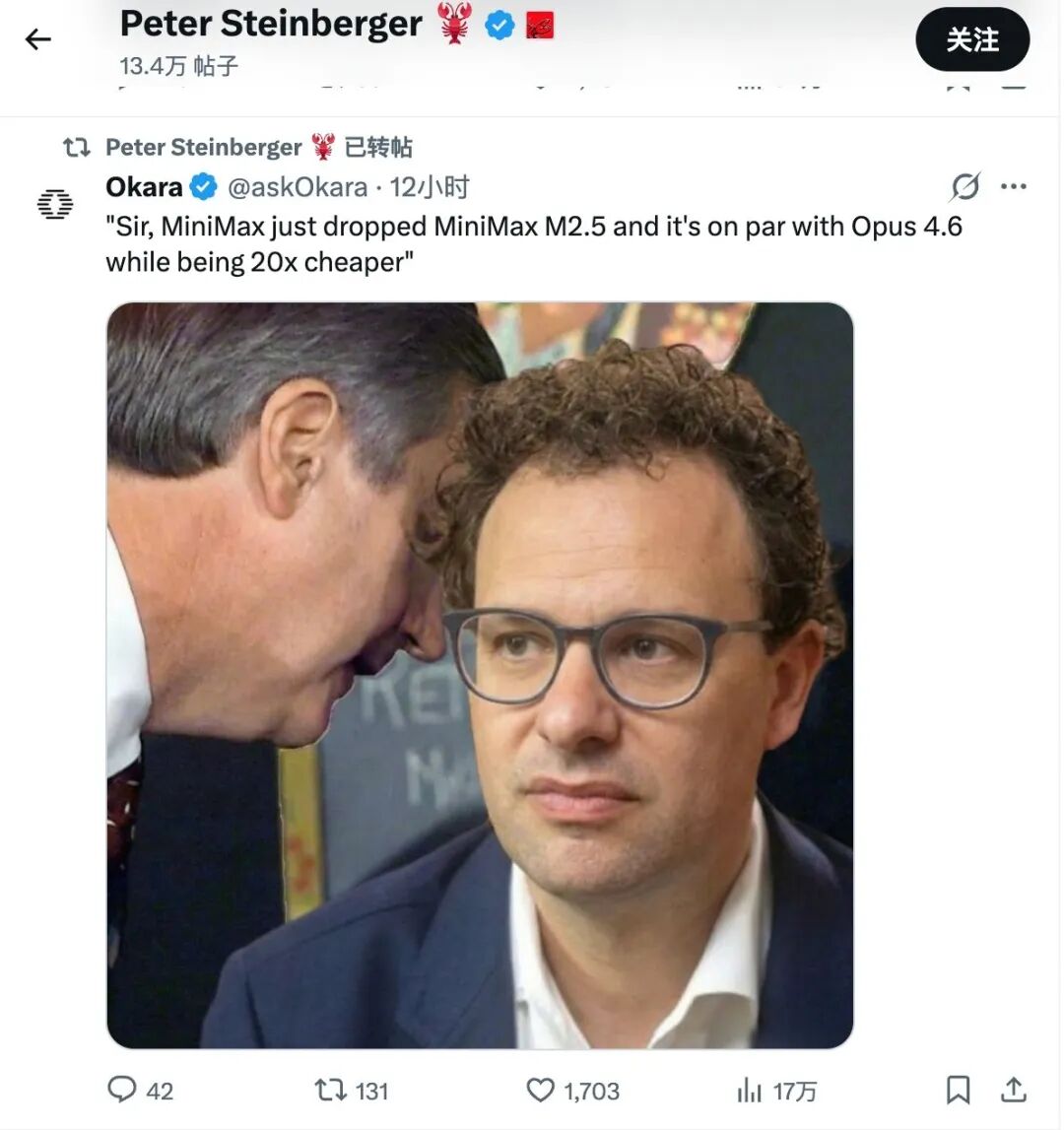
 OpenClaw founder Peter Steinberger has repeatedly recommended the MiniMax series models in interviews before. This time when M2.5 came out, he directly forwarded a post:
"MiniMax just released MiniMaxM2.5, its performance is comparable to Opus4.6, and the price is 20 times cheaper!"
 I really want to strongly recommend that everyone try it for themselves. M2.5 is completely a godsend for developers, with very strong development capabilities!
After using M2.5, I started to doubt whether it is necessary to renew Claude next month...

Core Advantages
M2.5 has a very high aesthetic and completion degree, and is especially good at handling some very complex development needs. Everyone can take a look at my second case later, it was completed very well, and it only took about 20 minutes at the time.
The official name for MiniMax M2.5 is intelligent agent native architecture. In other words, this model is born to work.
Its activation parameter size is only 10B. In contrast, flagship models like Claude Opus 4 have hundreds of B parameters. However, M2.5 can compete with top flagships in programming, document processing, and complex task execution.
I recently observed that many friends around me are doing website development projects or commercial platforms, and they still have to spend money to find outsourcing.
But I must say that MiniMax M2.5 can do all these tasks, and the effect is not inferior to many online platforms...
I ran 3 test scenarios, covering personal website development, commercial platform construction, and online education platform construction. Let's take a look at the practical effect of MiniMax M2.5👇
Practical Cases
Case 1: Beauty Blogger Wants to Create a Personal Brand Website
Some time ago, a friend who is a beauty self-media consultant came to me and said that she wanted to use AI to build a personal website to display some of her social media works, which would be convenient for Party A to see.
But she doesn't understand code at all, and outsourcing quotes outside start at several thousand.
Based on this requirement, I wanted to try whether I could directly use MiniMax M2.5 to get it done in one step.
 It first planned the entire website's technology stack and directory structure, and then started generating code page by page.
In some places, it will actively optimize, such as automatically adjusting the number of columns in the waterfall flow on the mobile terminal, and adding a smooth transition animation to the gradient background.
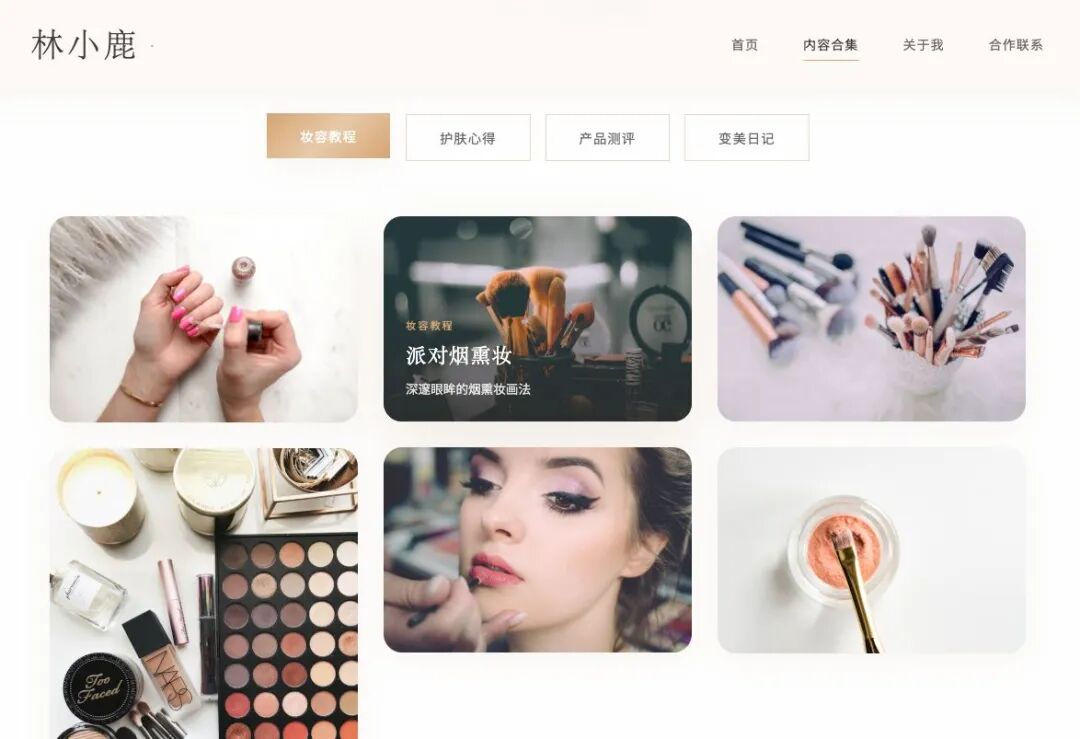 The whole process took only about three minutes, generating complete HTML, CSS and responsive layout code.
It can be seen that the practical value is really obvious, especially for personal bloggers and small studios with limited budgets, this capability directly reduces the cost of website construction from tens of thousands to zero.
 You only need to make requests, and all the remaining technical work is handed over to AI.
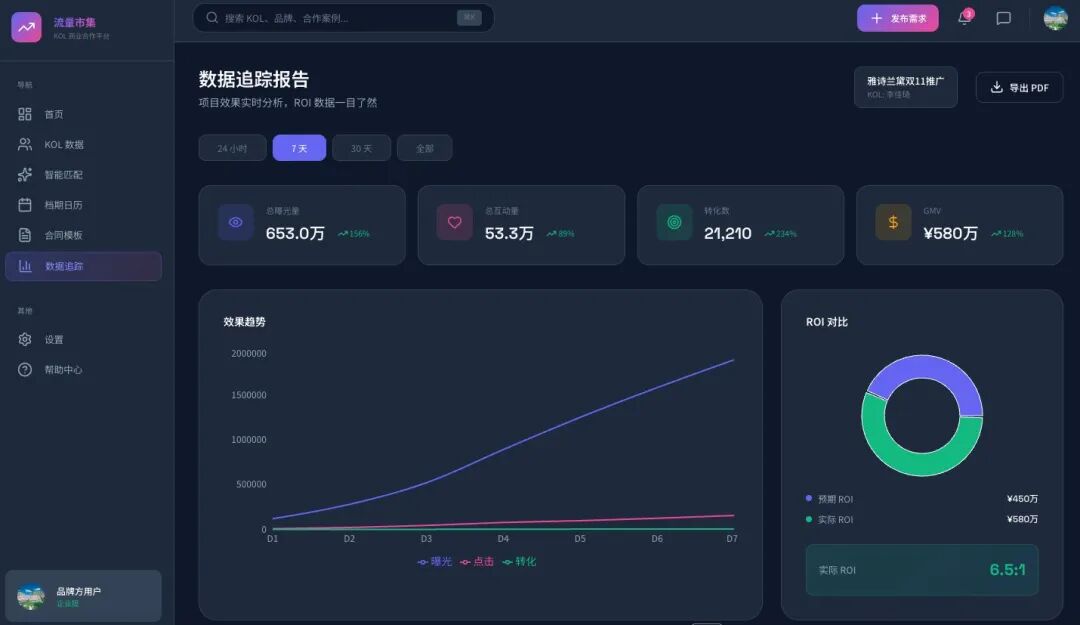
Case 2: Complex System of KOL Commercial Cooperation Platform
This case is a step up in difficulty. What I want to test is whether it can handle platform-type products with real business logic, not just a display website.I requested the creation of a KOL (Key Opinion Leader) business collaboration platform, featuring a data panel displaying fan profiles and quotations for influencers, an intelligent matching system that uses AI to recommend suitable KOLs after brand representatives input their needs, a schedule calendar with a visual display of scheduling for the next three months, a contract template library, and data tracking reports.
The visual style should resemble an Instagram card layout combined with a B2B SaaS dashboard style.
Its processing method is more systematic than the first case.
 First, the functional modules were broken down, and sub-systems such as the data panel, matching algorithm, calendar component, and document management were designed separately.
 Then, the front-end was linked together using a card flow layout, and the back-end logic was run through the entire process using simulated data.
Interestingly, when implementing the intelligent matching function, it proactively designed a simplified version of the recommendation algorithm. Although it's not a true machine learning model, the logic based on tag matching is already able to demonstrate the core concept.
The entire project took about 20 minutes to develop. At this level of complexity, it would almost certainly take a development team a month or two to complete.
 And I must say, this capability is of immense value to entrepreneurs.
If you have a business idea and want to quickly create an MVP (Minimum Viable Product) to validate the market, you can absolutely use this method to build a product prototype first, and then decide whether to invest resources in formal development.
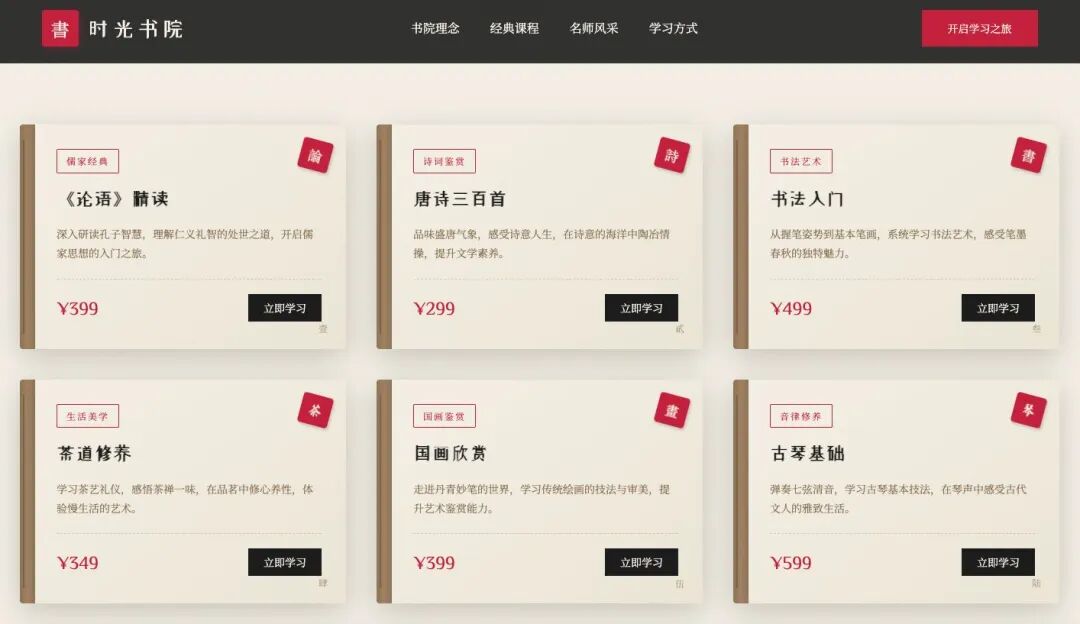
Case 3: Online Education Platform for New Chinese Aesthetics
For the third case, I wanted to test its performance in the cultural and creative direction. This type of requirement involves not only functional implementation but also aesthetics and atmosphere creation, which are often AI's weaknesses.
I requested a website for the Time Academy, an online Chinese studies education platform, with a new Chinese aesthetic. The color scheme should use gradients of creamy white, ink black, and cinnabar red, with calligraphy or ink wash paintings in the background, and a particle scattering effect. Incorporate ancient book elements such as bamboo scroll, and seals, and use Song typeface for vertical typesetting. Each course display box should resemble a thread-bound book, with ancient zither or tea art videos playing in the background. The overall atmosphere should be refined and tranquil, like sipping tea and discussing philosophy in a study.
During the execution process, it demonstrated an understanding of cultural symbols.
 In addition to implementing the basic visual style, it also made efforts in the details, such as adding ink wash transition animations to page switching, adding seal-style labels to course cards, and even triggering brush-writing path animations when the mouse hovers.
These small touches added灵气 (vitality) to the entire page, making it more than just a cold accumulation of code.
 As a result, when I sent this demo to a friend who works in cultural communication, her first reaction was to ask which design company I had hired.
When I told her it was done by AI, she didn't believe it at all.
So I say, the speed of AI's evolution in terms of aesthetics may be underestimated. It's not just imitating human design, but truly understanding cultural connotations and emotional expression.
Summary
After testing these cases, I feel that MiniMax M2.5's execution-level capabilities are indeed strong enough.
It can understand complex requirements, plan task steps on its own, and is incredibly fast. The official claim is that its inference speed is 3 times that of Opus, and my tests confirm this feeling.
If you are also often bogged down by execution-level琐事 (trivial matters), I highly recommend you test it yourself. The API interface is now open, and the key is to see if it can truly integrate into your workflow.
To be honest, at this stage of AI development, it's no longer a question of whether it can be used, but rather a question of how to use it.Get started early and benefit early.