Github Daily Best #1: Add Super Memory to AI Agents, Never Offline for 24 Hours
A few days ago, a friend complained that his AI robot was like an amnesiac. Every time it restarted, it forgot everything we had talked about before, and he had to repeat his preferences all over again.
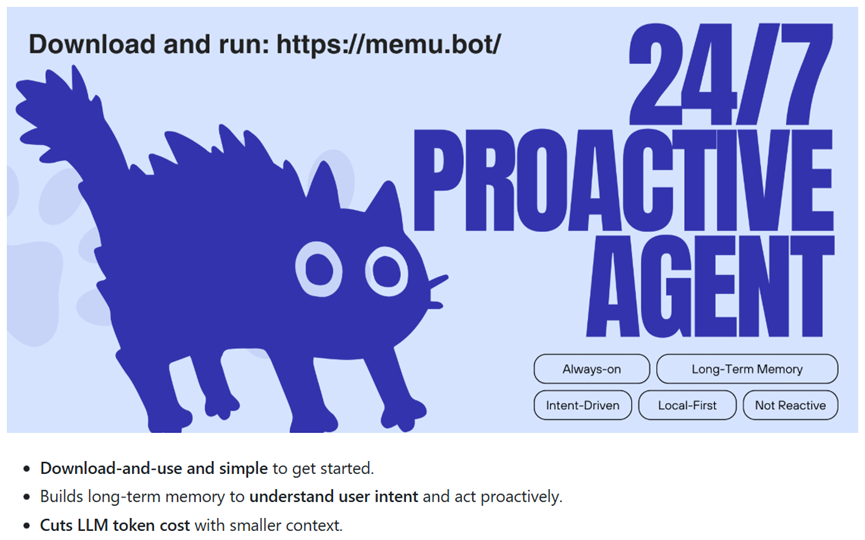
The worst part was that he wanted the robot to be online 24/7, but the cost of calling LLM was killing him.
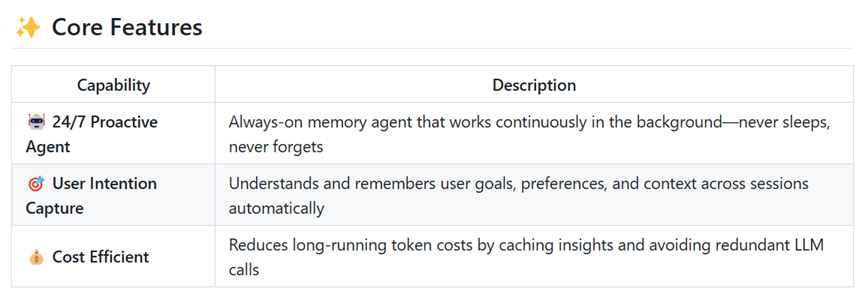
So, today I'm introducing memU, an open-source memory framework that took the top spot on Github's daily best list. Simply put, it's like giving AI a human-like super brain, so your robot doesn't forget anything for 24 hours and can even think proactively.
Open source address: https://github.com/NevaMind-AI/memU
In fact, memU is just an agent memory framework. Don't think of it as too complicated. Just think of it as AI's exclusive hippocampus. Our human hippocampus is responsible for storing and organizing memories, and MemU is the same.
Unlike ordinary storage tools, which only pile up data rigidly, it sorts information into categories like we do when we take notes, understands the meaning inside, and can store it for a long time, giving AI the ability to remember everything.
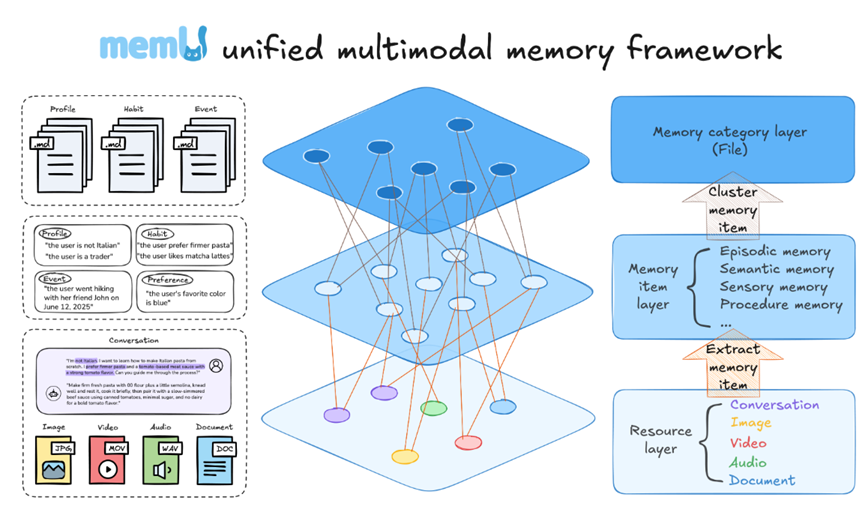
How amazing is this thing? Let me tell you in detail. The most direct feeling is that the robot will take the initiative to remember things. You casually mentioned that you are a vegetarian, and it silently remembered it.
The next time you ask for restaurant recommendations, it will directly give you a list of vegetarian restaurants, without you having to repeat it again. And this is not just simple rote memorization, it will understand the context like a person.
For example, if you said you wanted to learn Python before, and then you mentioned wanting to make a crawler, it can connect these two things and recommend related learning resources to you.
In terms of cost, it really saves a lot of money. memU caches those insights that have already been remembered to avoid repeated calls to LLM. It's like memorizing the multiplication table, so you don't have to do vertical calculations every time you do addition, subtraction, multiplication, and division.
In this way, the cost of long-term operation of the robot is directly reduced, and being online 24 hours is no longer a bottomless pit of burning money.
What I find most distinctive is the custom memory rules, which are very practical. Everyone's usage scenarios are different, and the needs are also different. MemU is very flexible. You can define your own memory types. For example, if you are in sales, you can add a customer preference type.
If you are in R&D, you can add a technology stack type. You can also classify and adjust the accuracy of retrieval to fully fit your own business scenarios.
For example, for the R&D team, each person's technology stack is different, so you can customize exclusive memory categories for the AI assistant to specifically record each person's technology stack.
Custom memory types and classifications, plus the technology stack type, and then divided into Python skills and Go language skills, re-initialize the service.
In this way, AI can accurately distinguish each person's skills, which is especially convenient when doing team skill inventory, without having to ask one by one.
Overall, memU is really suitable for developers who want to create a truly intelligent, non-amnesiac AI robot. Whether you are playing around as an individual or a formal company project, this framework can save you a lot of trouble.
Currently, this open source project with over 8000 stars is very popular. If you are interested, you can try it.